Blog

  • Xuất khẩu dầu Nga sau 4 năm phương Tây siết vòng vây

    Thu từ xuất khẩu dầu Nga đang thu hẹp về mức thấp nhất 5 năm do phương Tây liên tiếp bổ sung trừng phạt, Ấn Độ dè dặt thu mua.

    Tháng 1, thu ngân sách từ thuế dầu khí của Nga giảm xuống còn 393 tỷ ruble (5,1 tỷ USD), trong khi cùng kỳ năm ngoái, con số lên đến 1.120 tỷ ruble (14,5 tỷ USD). Theo Janis Kluge, chuyên gia về kinh tế Nga tại Viện Các vấn đề Quốc tế và An ninh Đức, đây là mức thấp nhất kể từ đại dịch.

    Như vậy, gần 4 năm kể từ ngày xung đột Ukraine nổ ra, thu từ dầu khí của Nga đang tiếp tục thu hẹp, do phương Tây siết chặt vòng vây trừng phạt theo thời gian.

    Đợt đầu tiên bắt đầu ngay hồi 2022, khi G7 áp trần giá 60 USD mỗi thùng dầu Nga, nhằm hạn chế nguồn thu của Moskva nhưng vẫn cho phép các nước thứ ba nhập khẩu, do lo ngại giá năng lượng tăng cao.

    Mức trần này từng giúp doanh thu dầu mỏ của Nga chỉ giảm tạm thời, đặc biệt sau khi EU cấm phần lớn dầu Nga vận chuyển bằng đường biển, buộc Moskva chuyển hướng bán sang Trung Quốc và Ấn Độ. Tuy nhiên, “đội tàu bóng tối” gồm các tàu chở dầu cũ hoạt động ngoài tầm kiểm soát của trần giá, dần hình thành sau đó, giúp sản lượng xuất khẩu tăng trở lại.

    Tàu chở dầu mang cờ Nga đậu tại cảng Marmara Ereglisi, Thổ Nhĩ Kỳ vào ngày 16/12022. Ảnh: Reuters
    Tàu chở dầu mang cờ Nga đậu tại cảng Marmara Ereglisi, Thổ Nhĩ Kỳ vào ngày 16/12022. Ảnh: Reuters

    Để tăng hiệu quả của giá trần khi thị trường dầu thô nói chung giảm giá, năm ngoái, EU và một số thành viên G7 gồm Anh và Nhật Bản quyết định hạ mức trần này xuống 44,1 USD mỗi thùng. Mỹ không tham gia vào vòng áp giá trần này nhưng Tổng thống Donald Trump chọn tung đòn khác.

    Theo đó, vào tháng 8/2025, ông áp thuế bổ sung 25% hàng Ấn Độ, với lý do nước này mua dầu từ Nga, nâng tổng thuế lên 50%. Kể từ khi xung đột Ukraine nổ ra, Ấn Độ dần nổi lên thành khách hàng lớn nhất của dầu Nga, với sản lượng nhập khẩu từng vượt 2 triệu thùng mỗi ngày vào giữa năm ngoái.

    Đến ngày 2/11/2025, Tổng thống Trump áp trừng phạt hai công ty dầu khí lớn nhất của Nga là Rosneft và Lukoil. Điều này đồng nghĩa bất kỳ ai mua hoặc vận chuyển dầu của họ đều có nguy cơ bị cắt khỏi hệ thống ngân hàng Mỹ, vấn đề nghiêm trọng với mọi doanh nghiệp đa quốc gia.

    Áp lực từ Mỹ dường như phát huy hiệu quả. Ngày 3/2, Tổng thống Trump thông báo hạ thuế hàng nhập khẩu của Ấn Độ từ 25% xuống 18% do Thủ tướng Narendra Modi đã đồng ý dừng nhập khẩu dầu Nga. Đến hôm 6/2, Mỹ cũng dỡ bỏ mức thuế bổ sung 25% áp lên Ấn Độ trước đó.

    Ông Modi chưa bình luận. Người phát ngôn Bộ Ngoại giao Ấn Độ Randhir Jaiswal cho biết chiến lược của nước này là “đa dạng hóa nguồn cung năng lượng phù hợp với các điều kiện thị trường khách quan”. Người phát ngôn Điện Kremlin Dmitry Peskov nói Moskva đang theo dõi các tuyên bố và vẫn cam kết “quan hệ đối tác chiến lược tiên tiến” với New Delhi.

    Lượng dầu Nga xuất sang Ấn Độ đã giảm trong những tuần gần đây, từ 2 triệu thùng mỗi ngày hồi tháng 10 xuống 1,3 triệu thùng mỗi ngày vào tháng 12/2025, theo số liệu của Trường Kinh tế Kyiv và Cơ quan Thông tin Năng lượng Mỹ. Công ty dữ liệu Kpler nhận định “Ấn Độ khó có khả năng rút lui hoàn toàn ” khỏi nguồn năng lượng Nga giá rẻ, trong ngắn hạn.

    Song song đó, EU hôm 21/1 ban hành gói trừng phạt thứ 20 lên Moskva. Khối cấm các loại nhiên liệu được sản xuất từ dầu thô Nga, tức dầu Nga không còn có thể được tinh chế ở nơi khác rồi xuất sang châu Âu dưới dạng xăng hoặc diesel.

    Theo ông Mark Esposito, chuyên gia phân tích cao cấp về dầu thô vận chuyển đường biển tại S&P Global Energy, việc EU đưa cả diesel và xăng vào diện trừng phạt tạo ra “một gói trừng phạt rất năng động, cú đánh kép, tác động không chỉ đến dòng chảy dầu thô mà còn cả các sản phẩm tinh chế từ những thùng dầu đó. “Nói một cách dễ hiểu: nếu nó xuất phát từ dầu thô Nga, thì coi như bị loại”, ông nêu.

    Chủ tịch Ủy ban châu Âu (EC) Ursula von der Leyen hôm 6/2 còn đề xuất cấm hoàn toàn các dịch vụ vận chuyển với dầu Nga. Bà cho rằng trừng phạt là đòn bẩy để buộc Nga chấm dứt giao tranh. “Chúng ta cần nhìn thẳng vào thực tế: Nga chỉ ngồi vào bàn đàm phán với thiện chí thực sự khi chịu đủ sức ép”, bà nói.

    EC cũng đề xuất bổ sung thêm 43 tàu thuộc “đội tàu bóng tối” của Nga vào danh sách trừng phạt, nâng tổng số lên 640 tàu tại Mỹ, Anh và EU. Lực lượng Mỹ đã thu giữ các tàu liên quan đến dầu Venezuela bị trừng phạt, trong đó có một tàu treo cờ Nga. Pháp cũng từng tạm thời chặn một tàu bị nghi thuộc đội bóng tối.
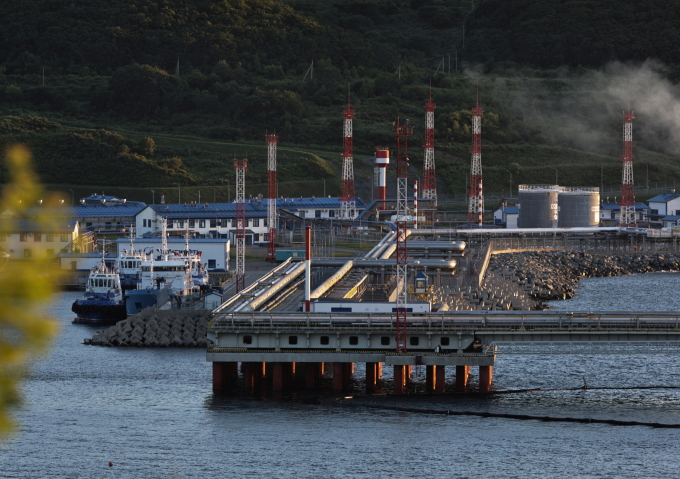
    Trạm tiếp nhận dầu thô ở vịnh Nakhodka, gần Nakhodka, Nga, ngày 12/8/2022. Ảnh:Reuter
    Trạm tiếp nhận dầu thô ở vịnh Nakhodka, gần Nakhodka, Nga, ngày 12/8/2022. Ảnh: Reuter

    Trước hoạt động trừng phạt ngày càng dày đặc của phương Tây, bên mua hiện yêu cầu mức chiết khấu lớn hơn với dầu Nga để bù đắp rủi ro và xử lý những phiền toái trong việc tìm giải pháp thanh toán. Mức chiết khấu đã nới rộng lên khoảng 25 USD mỗi thùng trong tháng 12, đẩy dầu Urals của Nga giảm xuống dưới 38 USD mỗi thùng, so với khoảng 62,5 USD mỗi thùng dầu Brent.

    Vì thuế khai thác dầu của Nga được tính dựa trên giá dầu, điều này trực tiếp làm giảm nguồn thu ngân sách. “Đây là hiệu ứng dây chuyền, hay hiệu ứng domino”, ông Mark Esposito tại S&P Global Energy, nhận định.

    Ngoài ra, việc các bên mua ngần ngại nhận hàng đã khiến khoảng 125 triệu thùng dầu bị tồn đọng trên các tàu ngoài khơi, đẩy chi phí vận chuyển tăng vọt lên đến 125.000 USD mỗi ngày, theo ông Esposito.

    Dầu bị ép giá và hạn hẹp đầu ra trong lúc tăng trưởng kinh tế Nga đang chững lại. Quý III/2025, GDP chỉ tăng 0,1%. Dự báo tăng trưởng 2025 của Nga dao động 0,6% đến 0,9%, thấp hơn nhiều so với mức trên 4% các năm 2023 và 2024.

    Để bù đắp khoảng trống do doanh thu dầu mỏ suy giảm và tăng trưởng chậm lại, Điện Kremlin chọn tăng thuế và vay nợ. Quốc hội Nga đã nâng thuế giá trị gia tăng (VAT) các giao dịch tiêu dùng tại quầy thanh toán từ 20% lên 22%, tăng thuế xe nhập khẩu, thuốc lá và đồ uống có cồn.

    Chính phủ cũng đẩy mạnh vay từ các ngân hàng trong nước. Ngoài ra, quỹ tài sản quốc gia còn dự trữ để hỗ trợ ngân sách. Vì vậy, Điện Kremlin vẫn còn tiền trong ngắn hạn. Nhưng tăng thuế có thể làm tăng trưởng chậm hơn. Trong khi, vay nợ tiềm ẩn nguy cơ làm tăng lạm phát, vốn đã được kéo xuống 5,6% nhờ lãi suất điều hành 16% của ngân hàng trung ương.

    “Nếu kéo dài thêm sáu tháng đến một năm, điều này cũng có thể ảnh hưởng đến cách họ (Moskva) suy nghĩ về cuộc chiến”, ông Kluge nhận dịnh. Không nghĩ thỏa thuận hòa bình sớm đạt được nhưng ông dự báo cường độ giao tranh có thể giảm.

    Phiên An (theo AP, Reuters)

    Các nhà máy lọc dầu Ấn Độ dừng đặt mua dầu Nga

    Các nhà máy lọc dầu Ấn Độ dừng đặt mua dầu Nga

    Các nhà máy lọc dầu Ấn Độ đang tránh đặt mua dầu Nga giao từ tháng 4, trong bối cảnh Washington và New Delhi xúc tiến thỏa thuận thương mại. 

    Điều gì xảy ra nếu Ấn Độ ngừng mua dầu Nga\?

    Điều gì xảy ra nếu Ấn Độ ngừng mua dầu Nga?

    Ấn Độ có thể tốn thêm 11 tỷ USD mỗi năm nếu không mua dầu Nga, khiến Moskva chịu thêm sức ép ngân sách và giá dầu thô tăng tốc.  65

    Doanh thu dầu khí Nga có thể thấp nhất 5 năm

    Doanh thu dầu khí Nga có thể thấp nhất 5 năm

    Giá dầu thấp và đồng ruble mạnh lên được dự báo khiến doanh thu dầu khí Nga tháng này có thể thấp nhất kể từ tháng 8/2020.  47

      Trở lại Kinh doanh

    Save

    Most Viewed

    Doanh nhân Trịnh Văn Quyết muốn thuê tàu bay Boeing 737 Max cho Bamboo Airways

    Doanh nhân Trịnh Văn Quyết muốn thuê tàu bay Boeing 737 Max cho Bamboo Airways 

    Luân chuyển toàn bộ công chức thuế nhà đất, vàng bạc

    Luân chuyển toàn bộ công chức thuế nhà đất, vàng bạc 

    Cây cảnh, hoa chơi Tết giảm giá một nửa để xả hàng sớm

    Cây cảnh, hoa chơi Tết giảm giá một nửa để xả hàng sớm  75

    Opinions

     (29

    )

    Most Interested Latest

    T

    Tuan TravelKinh tế Mỹ mạnh nhất thế giới nhờ:
    1. AI
    2. Hàng không – Vũ trụ
    3. Chip – Bán dẫn
    4. Khoa học Công nghệ, quân sự…
    Kinh tế Nga tồn tại là nhờ vào:
    1. ĐÀO
    2. HÚT
    3. XÚC
    4. MÚC

    Like

    101

    Reply 7h trước

    8 trả lời

    T

    Tuan Travel“Mức chiết khấu đã nới rộng lên khoảng 25 USD mỗi thùng trong tháng 12, đẩy dầu Urals của Nga giảm xuống dưới 38 USD mỗi thùng, so với khoảng 62,5 USD mỗi thùng dầu Brent.”
    Kinh tế đã phụ thuộc hút dầu khí lên bán rồi, sau đó còn phải chiết khấu cao ngất ngưỡng, giờ chả ai dám mua nữa luôn. Mệt mỏi thật sự rồi!

    Like

    47

    Reply 7h trước

    T

    ThegioiaoTừ từ cháo mới nhừ

    Like

    46

    Reply 8h trước

    vuthanhtrung2005Thế cưỡi lưng hổ….của nước Nga!

    Like

    37

    Reply 8h trước

    n

    nongvandanthanhphoTăng thuế thì ảnh hưởng trực tiếp tới đời sống người dân

    Like

    24

    Reply 7h trước

    H

    Huỳnh Anh VũKhi ép 01 cái lò xo, lực ép càng mạnh thì phản lực càng dữ dội. Mong mọi người biết điều này 

  • Ứng dụng phim ngắn lên ngôi ngày Tết

    Vô tình lướt trúng một đoạn phim ngắn ngày nghỉ Tết, Phương Thúy bị cuốn vào nội dung, đã mạnh dạn chi tiền để tải app xem phim ngắn.

    Bắt đầu từ một đoạn phim dài hơn 15 phút mà cô bắt gặp trên Facebook trong lúc trông nồi bánh chưng, Phương Thúy, 25 tuổi ở Phú Thọ, thừa nhận cô “không thể ngừng xem được”. Đoạn phim kể câu chuyện tình yêu – trả thù với nhịp dồn dập, liên tục. Đến khi câu chuyện bắt đầu bước vào đoạn gay cấn nhất cũng là lúc video kết thúc, kèm dòng giới thiệu xem trọn bộ trên ứng dụng. Tò mò xen lẫn khó chịu, cô quyết định bấm tải app được gắn kèm.

    Vào ứng dụng, mỗi tập chỉ dài 2-3 phút. Sau những tập đầu phát miễn phí, đến đúng đoạn cao trào tiếp theo của bộ phim, cô được yêu cầu trả phí để mở khóa xem tiếp. “Đã xem gần nửa tiếng rồi thì không thể bỏ giữa chừng”, Thúy kể, quyết định mua gói gần 150.000 đồng để xem đến hết kỳ nghỉ Tết.

    Một người đang xem ứng dụng Short Drama trên điện thoại. Ảnh: Lưu Quý
    Một người đang xem ứng dụng Short Drama trên điện thoại. Ảnh: Lưu Quý

    Loại hình nội dung mà cô xem được gọi là Short Drama, phổ biến trong vài năm trở lại đây. Ngày 15/2 (28 Tết), bảng xếp hạng App Store Việt Nam ghi nhận hàng loạt ứng dụng Short Drama trong top 10, trong đó dẫn đầu là DramaBox, NetShort, DreamWave… vượt lên trên loạt ứng dụng quen thuộc như TikTok, YouTube.

    Trên Android, DramaBox cũng là một trong những ứng dụng trong top tải nhiều, thậm chí được nền tảng này quảng bá như một hình thức giải trí đáng thử nghiệm dịp Tết Nguyên đán.

    Theo chuyên gia về nội dung số, sự trỗi dậy của các ứng dụng phim ngắn diễn ra trong bối cảnh người dùng có xu hướng tìm kiếm nội dung giải trí nhanh, dễ theo dõi trong thời gian ngắn. “Dịp Tết, khi thời gian biểu bị chia nhỏ bởi các hoạt động gia đình, di chuyển, chúc Tết, những nội dung 1-3 phút mỗi tập trở nên phù hợp hơn so với phim truyền hình dài tập hay điện ảnh”, chuyên gia này đánh giá. “Loại hình này cũng phù hợp với hành vi giải trí ngắt quãng của người dùng smartphone hiện nay”.

    2 trong 3 ứng dụng được tải nhiều nhất trên App Store ngày 15/2 là ứng dụng Short Drama. Ảnh chụp màn hình
    2 trong 3 ứng dụng được tải nhiều nhất trên App Store ngày 15/2 là ứng dụng Short Drama. Ảnh chụp màn hình

    Khác với video ngắn trên mạng xã hội, Short Drama được xây dựng bởi các đội ngũ chuyên nghiệp, được làm theo cấu trúc phim nhiều tập, có kịch bản, cao trào và kết thúc mở. Mỗi tập thường chỉ vài phút, kết thúc ở điểm gây tò mò để giữ chân người xem. Mô hình này từng bùng nổ tại Trung Quốc và Mỹ trong hai năm gần đây trước khi lan sang Đông Nam Á.

    Hầu hết ứng dụng short drama theo mô hình “freemium”, tức cho người dùng xem miễn phí một số tập đầu, sau đó phải trả phí hoặc mua xu, hoặc chấp nhận xem quảng cáo để mở khóa tập tiếp theo. Chẳng hạn một ứng dụng phim ngắn thuộc top tải nhiều thời gian qua, cho phép mua xu để mở khóa từng tập, với giá trung bình khoảng có thể vào khoảng vài nghìn đồng cho mỗi tập phim 2-3 phút, hoặc trả phí 150.000 đồng/tuần, 2.000.000 đồng/năm.

    Việt Nam nằm trong nhóm thị trường nổi bật tại châu Á cho Short Drama. Theo Báo cáo thị trường ứng dụng 2025 của Sensor Tower, các ứng dụng Short Drama đã chen chân vào nhóm ứng dụng giải trí phổ biến nhất, thay vì chỉ là sản phẩm ngách. Vào quý 4/2025, các ứng dụng Short Drama đã vượt qua các dịch truyền hình (OTT Streaming) tại Việt Nam về lượt tải. Về doanh thu trong ứng dụng (IAP Revenue), vị trí số một cũng thuộc về một ứng dụng phim ngắn.

    Dữ liệu của Sensor Tower về lượt tải các ứng dụng phim, trong đó phim ngắn vượt qua các ứng dụng truyền hình. Ảnh chụp màn hình
    Dữ liệu của Sensor Tower về lượt tải các ứng dụng giải trí, trong đó phim ngắn vượt qua các ứng dụng truyền hình trong năm 2025. Ảnh chụp màn hình

    Dù được tải nhiều, các ứng dụng Short Drama cũng đứng trước một số lo ngại, như khả năng kiểm soát nội dung. Do phần lớn short drama được phân phối qua nền tảng riêng, quy trình kiểm duyệt và phân loại độ tuổi chưa đồng bộ như truyền hình hay OTT lớn. Do sản xuất với tốc độ nhanh và chi phí thấp, nhiều bộ phim bị đánh giá có kịch bản rập khuôn, khai thác mô-típ gây sốc, ngoại tình, trả thù, để giữ chân người xem, thay vì đầu tư chiều sâu nghệ thuật.

    Ngoài ra, tương tự các app trả phí khác, các ứng dụng Short Drama cũng thường đưa ra các chiêu để thu hút người dùng đăng ký gói trả phí với mức cao. Người dùng cần tính toán trước về nhu cầu sử dụng để đăng ký gói phù hợp, hủy đăng ký khi không sử dụng.

    Lưu Quý

      Trở lại Khoa học công nghệ

    Save

    Most Viewed

    Starlink được cấp phép Internet vệ tinh tại Việt Nam

    Starlink được cấp phép Internet vệ tinh tại Việt Nam  114

    Elon Musk dự đoán nghề lập trình ‘chết’ cuối năm nay  108

    Làn sóng gom chip nhớ lãi hơn vàng  25

    Opinions

     (5

    )

    Most Interested Latest

    t

    transigmatpnPhải công nhận phim ngắn Trung Quốc tuy cốt truyện phi lý (trùng sinh, trả thù, xuyên không về quá khứ, năng lực đặc biệt…) nhưng lại khá cuốn hút. Đầu tư hình ảnh cũng rất kỹ luỡng – từ trang phục, bối cảnh hoàng cung đến biệt thự, mọi chi tiết đều chỉn chu.

    Like

    1

    Reply 1h trước

    K

    KiếnNgày tết nên đi đây đi đó, tận hưởng niềm vui không khí tết rộn ràng khắp mọi miền đất nước. Mấy cái app phim ngắn, phim dài nên để dành cho tuổi già, khi mà đôi chân đã không còn cất bước được nữa, lúc đó nằm coi 365 ngày/năm cũng chưa muộn.

    Like

    1

    Reply 1h trước

    1 trả lời

    j

    joxabo4113À, đây là cách moi tiền người dùng hoàn hảo nhất đấy đấy ạ !!!!. Hãy xem kìa, tại sao chỉ dài có 3 phút thì đi liền với chưa hết phim kia kìa !!!. Đã thế lại gợi ý người dùng dùng app để tải phim tập tiếp theo nhưng không được miễn phí kia kìa !!!. Đúng là người ta không cho chúng ta không cái gì cả ạ !!!. Kể cả là các bạn cúng dường vô số thiên hà bằng vàng, bạc, bạch kim, kim cương cho thần linh để bạn được mừng tuổi lại đúng số tiền đã cúng dường cho thần thánh đấy nhé ạ !!!.
    Xin cảm ơn ạ !!!.

    Like

    Reply 11′ trước

    l

    liuyifei393Tải xong về 1-2 phim xem hết chán lun. nên xem ytb thôi mn

  • 2 Singapore restaurants to close in March amid continued turbulence

    Relish, a home-grown burger restaurant, and Ibid, a fine-dining establishment, will shut their doors in March as Singapore’s food and beverage sector continues to face headwinds.

    Founded by chef Willin Low, Relish, the casual 80-seat eatery at Cluny Court, will close on March 29 after a 19-year run.

    It has built a loyal following for signatures such as the Bacon & Double Cheese Beef Burger and Ram Lee Beef Burger alongside pasta dishes including Hae Bee Hiam Spaghettini and Roketto Oyster Omelette Spaghettini.

    Low, 54, told The Straits Times on Feb. 10 that the landlord has secured a new tenant for the space.

    Relish currently employs 11 full-time and three part-time staff.

    Also set to close in March is Ibid, a 16-seat fine-dining restaurant in North Canal Road helmed by Woo Wai Leong, winner of the 2015 reality cooking show MasterChef Asia.

    Leong opened the restaurant in 2017, serving tasting-menu dinners focused on Asian flavors, Asia One reported.

    The final day of service has yet to be determined.

    The closures come amid continued turbulence in the food and beverage sector.

    According to statistics from the Accounting and Corporate Regulatory Authority, 3,148 food businesses ceased operations in 2025, up from 3,047 in 2024.

    Recent closures include French restaurant and wine bar Loulou in Keong Saik Road, Chef’s Tavern, Spanish establishments Sabio and Sugarra, contemporary Asian restaurant Asu, brunch spot Open Farm Community, Tiong Bahru Bakery Safari in Dempsey, Korean restaurant Onmi, Ruth’s Chris Steak House and Hooters in Clarke Quay.

    Singapore restaurant, once listed among Asia's best, to close after 14 years

    Singapore restaurant, once listed among Asia’s best, to close after 14 years

    Singaporean restaurant Lolla, located at Ann Siang Hill, will close after its final service on Feb. 14, joining a growing list of food and beverage outlets that have shut down in the city-state in recent years.

    Singapore restaurant Halia to shut down after 25 years

    Singapore restaurant Halia to shut down after 25 years

    The Halia Restaurant at the Singapore Botanic Gardens will close in mid-March after 25 years of operation, adding to a growing list of food and beverage outlets that have shut down in the city-state in recent years.

    Singapore's East Ocean Teochew Restaurant to shut down after 33 years of operation

    Singapore’s East Ocean Teochew Restaurant to shut down after 33 years of operation

    East Ocean Teochew Restaurant, a well-known name for Teochew-Cantonese dishes and handcrafted dim sum, will close on Dec. 28 after 33 years in business.

    Which is Asia's best fine dining restaurant?

    Which is Asia’s best fine dining restaurant?

    Koma Singapore was voted the best fining restaurant in Asia as part of the 2025 Travelers’ Choice “Best of the Best” Restaurants Awards based on an analysis of reader reviews on travel platform Tripadvisor.

    Malaysian seafood noodle chain Hai Kah Lang to open first Singapore outlet

    Malaysian seafood noodle chain Hai Kah Lang to open first Singapore outlet

    Hai Kah Lang, the Malaysian seafood noodle brand known for rich broths and fresh seafood, will open its first overseas outlet at Singapore’s Funan mall later this month.

  • World’s second most visited country shifts focus to sustainable tourism amid record arrivals

    Most Read

    1.

    2 Singapore restaurants to close in March amid continued turbulence

    2 Singapore restaurants to close in March amid continued turbulence

    2.

    Grandsons of Singapore ‘rubber king’ Lee Kong Chian pay $53M for three luxury homes

    Grandsons of Singapore ‘rubber king’ Lee Kong Chian pay $53M for three luxury homes

    3.

    Malaysia has positive chance of beating FIFA in court: AFC

    Malaysia has positive chance of beating FIFA in court: AFC

    4.

    Malaysian airports face complaints over expensive food

    Malaysian airports face complaints over expensive food

    5.

    Ho Chi Minh City unveils design of mega sea link between Can Gio and Vung Tau

    Ho Chi Minh City unveils design of mega sea link between Can Gio and Vung Tau

    6.

    Vietnam proposes $755M expressway link between Ho Chi Minh City and Phnom Penh

    Vietnam proposes $755M expressway link between Ho Chi Minh City and Phnom Penh

    7.

    Hong Kong actor Liu Wai Hung to open fishball shop in Kuala Lumpur

    Hong Kong actor Liu Wai Hung to open fishball shop in Kuala Lumpur

    8.

    Vietnam's two busiest airports brace for record Tet crowds

    Vietnam’s two busiest airports brace for record Tet crowds

    9.

    Hong Kong’s 5 richest billionaires own $141B, with most held by ‘big four’ tycoon families

    Hong Kong’s 5 richest billionaires own $141B, with most held by ‘big four’ tycoon families

    10.

    Ride-hailing drivers worn down in quest for Lunar New Year windfall

    Ride-hailing drivers worn down in quest for Lunar New Year windfall

    Recommend for you

    Tan Son Nhat Airport crowded as Tet travelers rush home

    Tan Son Nhat Airport crowded as Tet travelers rush home

    Chinese tourists head to Australia, Thailand on extended Lunar New Year break

    Chinese tourists head to Australia, Thailand on extended Lunar New Year break

    Vietnam's two busiest airports brace for record Tet crowds

    Vietnam’s two busiest airports brace for record Tet crowds

    Tet congestion in HCMC slows emergency response despite sirens

    Tet congestion in HCMC slows emergency response despite sirens

    Police in France detain 9 people in suspected massive Louvre ticket fraud scheme

    Police in France detain 9 people in suspected massive Louvre ticket fraud scheme

    World’s second most visited country shifts focus to sustainable tourism amid record arrivals

    By Hoang Vu    February 11, 2026 | 03:20 pm PT

    World's second most visited country shifts focus to sustainable tourism amid record arrivals

    Tourists enjoy the beach at the Mediterranean Sea in Lloret de Mar, Spain, July 11, 2025. Photo by Reuters

    Spain is seeking to rebalance tourism and daily life after a record influx of visitors in 2025 intensified pressure on housing and living costs for residents.

    The country welcomed 96.8 million foreign tourists last year, a 3.2% increase from 2024, making it the second most visited country globally, behind France with 105 million visitors, according to figures released on Feb. 3 by the National Statistics Institute.

    While the surge underscores the sector’s strong recovery, it has also fueled growing public dissatisfaction, Euro News reported.

    Residents in major destinations have raised concerns about overcrowding, rising house prices, limited housing supply, and the strain on resources such as water, particularly where tourism infrastructure has expanded, Reuters reported.

    Many also say higher living costs mean they can no longer afford holidays in their own resort areas.

    City centers have been especially affected, as the spread of short-term rentals has reduced long-term housing availability and driven up rents, adding to tensions between locals and visitors.

    Spain’s tourism ministry said in a statement the increase in visitor numbers and spending aligns with its goal of transforming the sector into a more sustainable model that prioritizes quality over quantity, aiming to reduce social and environmental pressures while maintaining economic benefits.

    The “quality over quantity” approach is already evident in Spanish cities, which have moved to cap the number of licenses issued for short-term rentals, issued guidelines to visitors on meeting local etiquette expectations, and tightened rules on public behavior — including bans on smoking on beaches, according to Travel Tomorrow.

    Spain blocks more than 65,000 Airbnb holiday rental listings

    Spain blocks more than 65,000 Airbnb holiday rental listings

    Spain has ordered Airbnb to withdraw more than 65,000 listings for holiday rentals which it said violated existing rules from its platform as part of a general crackdown on a business blamed for contributing to the housing crisis in the country.

    Tourists face $800 fines for going shirtless in Spain

    Tourists face $800 fines for going shirtless in Spain

    Visitors in Malaga, one of Spain’s most popular destinations, will face fines of up to 750 euros (US$832) if caught going shirtless or wearing only underwear in public, under a new regulation effective from September.

    Spain's Seville plans to charge fee for visiting landmark square

    Spain’s Seville plans to charge fee for visiting landmark square

    Tourists visiting the southern Spanish city of Seville may soon have to pay a fee to explore the wide, ornate Plaza de Espana square, the city hall said, as part of plans to control tourist overload in a public open space.

    'Go home': Too much tourism sparks backlash in Spain

    ‘Go home’: Too much tourism sparks backlash in Spain

    Anti-tourism movements are multiplying in Spain, the world’s second most visited country, prompting the authorities to try and reconcile the interests of locals and the lucrative sector.

  • The Drukpa Buddhist lineage shaping Bhutan’s national identity

    Over centuries the Drukpa Lineage has become the central religious tradition in Bhutan, shaping the cultural identity of this South Asian nation renowned for its Gross National Happiness index.

    Bhutan is a small kingdom on the southern slopes of the Himalayas, situated between India and China, and deeply influenced by Vajrayana Buddhism.

    Among its traditions is the Drukpa Kagyu lineage, which has forged the country’s history, authority and culture for centuries, from its name to its national symbols.

    Bhutan’s local name is Druk Yul (Land of the Thunder Dragon), and its king bears the title Druk Gyalpo (Dragon King).

    The national flag features a dragon along a diagonal line dividing the flag into yellow and orange halves, with yellow symbolizing the king and orange representing the spiritual tradition and the flourishing of Buddhism in general.

    Origins of Drukpa Lineage

    The Drukpa Lineage traces its origins back 1,000 years to India, beginning with the great Mahasiddha Naropa (1016–1100), known as the “Northern Gate Protector” of the ancient Nalanda University.

    It is a branch of the Kagyu (oral transmission) tradition in Himalayan Vajrayana Buddhism, with a lineage transmitted from Vajradhara Buddha to renowned Mahasiddhas Tilopa, Naropa, Marpa, Milarepa, Gampopa.

    After Gampopa, the Kagyu tradition divided into several branches.

    The Lingre branch, founded by the Mahasiddha Lingchen Repa, became the direct predecessor of the first Drukpa master, Drogon Tsangpa Gyare Yeshe Dorje.

    In the late 12th century Tsangpa Gyare, a principal disciple of Lingchen Repa, traveled in search of a sacred site to establish the Namdruk Monastery. He arrived in Nam-gyi Phu, not far from Lhasa, Tibet.

    Legend has it that he witnessed nine sacred dragons rising from the earth amid thunderous sounds, leading him to found the Drukpa lineage (Druk meaning “dragon”).

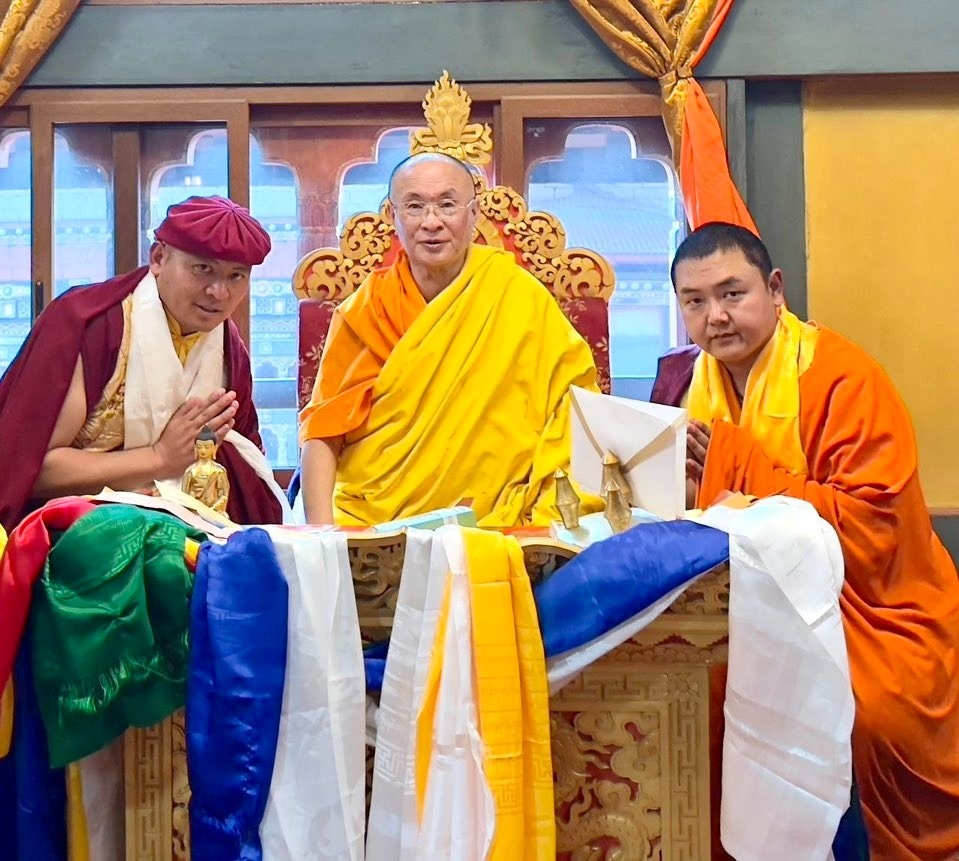
    His Holiness Trulku Jigme Chhoeda (C), the 70th and current Je Khenpo (Chief Abbot) of Bhutan, is with His Eminence Thuksey Rinpoche (L) and His Eminence Gyalwa Dokhampa at the Global Peace Prayer Festival in Thimphu, Bhutan in November 2025. Photo courtesy of Drukpa
    His Holiness Trulku Jigme Chhoeda (C), the 70th and current Je Khenpo (Chief Abbot) of Bhutan, is with His Eminence Thuksey Rinpoche (L) and His Eminence Gyalwa Dokhampa at the Global Peace Prayer Festival in Thimphu, Bhutan in November 2025. Photo courtesy of Drukpa

    Over the next five centuries the Drukpa Lineage, led by successive reincarnations of Tsangpa Gyare, grew across the Himalayan region.

    Its influence became extensive enough for a local saying to be widely quoted:

    “Half the people are disciples of the Drukpa Lineage,
    Half of the Drukpa disciples are yogis,
    Half of the yogis are Mahasiddhas.”

    In the early 17th century Zhabdrung Ngawang Namgyal, the reincarnation of the fourth Drukpa spiritual leader, the omniscient Kunkhyen Pema Karpo, spread the Drukpa Lineage, unified local communities and laid the foundation for the modern Bhutanese state.

    Zhabdrung established the “dual system” (Chosi Nyiden), consisting of a religious pillar led by the Je Khenpo (Chief Abbot) and a secular pillar led by the Desi (temporal ruler), while he himself stood as the supreme symbol of the nation.

    The national monastic system largely belongs to the Drukpa Lineage and is state-supported. The Je Khenpo, head of the religious pillar, is appointed by the king. This structure remained the country’s distinctive political foundation for centuries.

    National rituals, festivals, architecture, and traditional dress all bear the imprint of the Drukpa influence.

    From absolute monarchy to constitutional monarchy

    In 1907 Bhutan transitioned to a secular monarchy under the Wangchuck dynasty.

    Political power became increasingly centralized, gradually replacing the dual system, though the central role of the Drukpa Lineage was maintained.

    The current king, Jigme Khesar Namgyel Wangchuck, has reigned since 2006. He serves not only as head of state but is also regarded as the current protector of the Drukpa Lineage.

    Quốc vương Jigme Khesar Namgyel Wangchuck và Hoàng hậu Jetsun Pema tại Punakha, miền tây Bhutan, tháng 10/2011. Ảnh: Reuters
    King Jigme Khesar Namgyel Wangchuck and Queen Jetsun Pema in Punakha, western Bhutan, October 2011. Photo by Reuters

    In 2008 Bhutan transitioned to a constitutional monarchy and held its first general election.

    Although the Constitution does not designate an official state religion, it recognizes the special position of Vajrayana Buddhism in politics and society.

    The king continues to serve as patron of religion, while the monastic system remains a moral and cultural pillar of Bhutanese society.

    Educated at Oxford University in Britain and the National Defense Academy of India, the king possesses a foundation and skills that enable him to communicate effectively with younger generations.

    During public events such as National Day, thousands gather to hear him speak, expressing admiration through songs.

    For this reason, King Jigme Khesar Namgyel Wangchuck is often called the “People’s King,” a title reflecting his close relationship with the people.

    He is on record as saying: “Throughout my reign, I will not rule my people as a king. I will protect my people as a father, care for them as a brother and serve them as a son.”

    This spirit is reflected in his vision for the Gelephu Mindfulness City, announced in December 2023, a special administrative region that is expected to serve as a catalyst for administrative reform and economic growth.

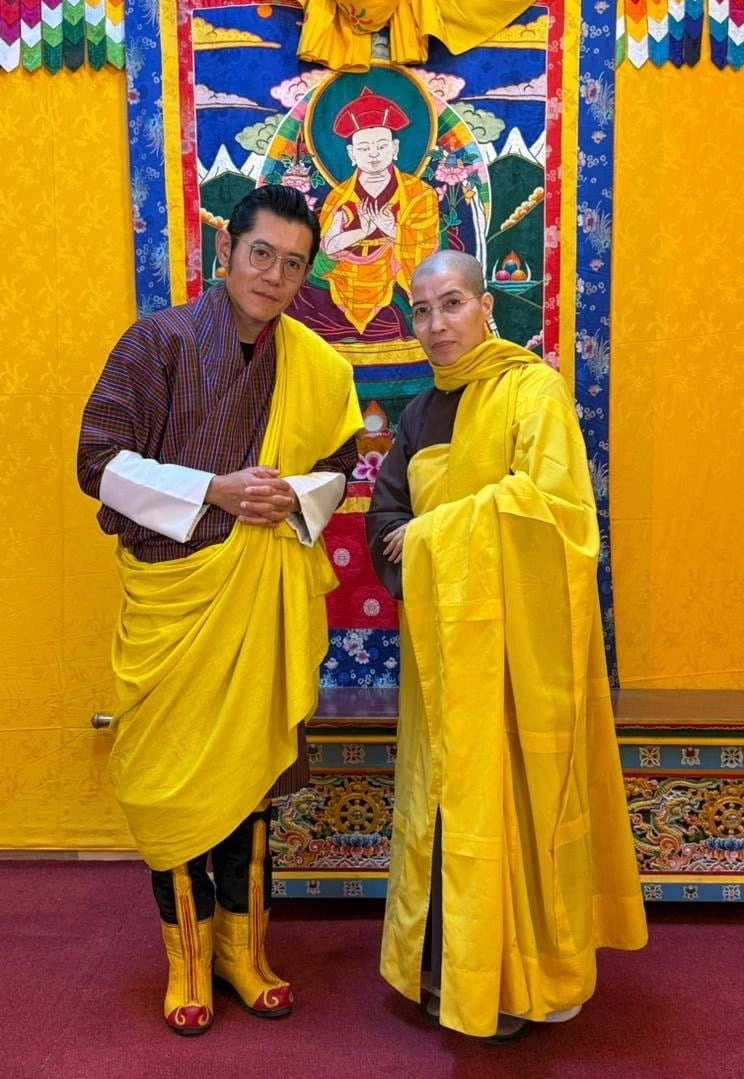
    Quốc vương Bhutan cùng Ni sư trụ trì Đại Bảo tháp Mandala Tây Thiên tại Đại lễ Cầu nguyện Hòa bình thế giới 2025 ở Bhutan. Ảnh: Nhân vật cung cấp
    The King of Bhutan with the Abbess of the Mandala Tay Thien Great Stupa at the Global Peace Prayer Festival in Thimphu, Bhutan in November 2025. Photo provided

    Under the project Bhutan plans to build a new, larger international airport with a longer runway capable of accommodating large aircraft flying on long-haul routes.

    During the National Day ceremony on Dec. 17, 2025, King Wangchuck announced the allocation of 10,000 BTC (Bitcoin), now valued at around US$650 million, for investment in the project.

    “I must ensure that every Bhutanese citizen is a guardian, a shareholder, and a beneficiary of the Gelephu Mindfulness City,” the king stated.

    Bhutan is well known for its Gross National Happiness index, which combines Buddhist philosophy with public policy to emphasize balance between material well-being, spirituality, environment, and culture rather than prioritize economic growth at all costs.

    The Drukpa Lineage provides the philosophical foundation for this model, enabling people to embrace development oriented toward happiness and well-being rather than solely GDP.

    This means Bhutan can keep close ties between religion and state despite integrating into an international order.

    International influence of the Drukpa Lineage

    With a 1,000-year heritage the Drukpa Lineage holds a distinctive place in Buddhist history. More than 80% of the population of Ladakh, an Indian centrally-governed territory, are its disciples.

    It also exerts a broad influence across the Himalayan region, including in Nepal and several northern Indian areas.

    In the 21st century the Drukpa Lineage has expanded beyond the Indian Himalayas and is now present in many countries, including in the west.

    The current spiritual leader, His Holiness the Gyalwang Drukpa, is influential not only religiously but also in intercultural and social dialogue, with internationally recognized contributions.

    Born in 1963 into a renowned family of Vajrayana practitioners in India, he has spent more than 50 years teaching Buddhism worldwide.

    He has initiated humanitarian projects and promoted volunteer groups focused on environmental protection, disaster relief, education, healthcare, and heritage conservation.

    Mở tranh thêu Phật cầu an trên bảo tháp Mandala
    People gather at the Dharma Assembly Program at Tay Thien Mandala Great Stupa in Vietnam’s nothern province of Vinh Phuc on Feb. 7, 2025. Video by VnExpress

    He has visited Vietnam 12 times, most recently in 2025, to take part in activities for praying for peace and prosperity and for cultural and religious exchanges, including a three-day Dharma ceremony at the Mandala Stupa in Dai Dinh Commune, Tam Dao, Vinh Phuc Province, around 80 km from Hanoi.

    The Mandala Stupa is situated near the Tay Thien Special National Relic Site. The 37-meter structure is in the architectural style of Himalayan Vajrayana’s great stupas.

  • Hanoi waives public transport fares during Tet holiday

    Hanoi Railways Company Limited will grant free single-ride tickets to passengers using the Hanoi Metro app or purchasing directly at ticket counters from Feb. 14-22 to meet rising travel demand during the Lunar New Year holiday.

    The company described the policy as an early spring gift to residents and visitors, aimed at promoting public transport use, reducing traffic congestion, and providing safe, convenient and environmentally friendly journeys.

    During the same period, the Hanoi Traffic Operation Center, in coordination with bus operators, will also waive fares on subsidized bus services. The program will apply to 128 subsidized routes citywide over the nine days, with passengers granted tickets according to route pricing but paying no fare.

    According to the municipal Department of Construction, the initiative is intended to support travel to central areas for festive events, enhance Hanoi’s image as a modern and green capital, ease congestion, and improve residents’ quality of life.

    The Lunar New Year begins on Feb. 17 and Vietnam will take a nine-day break from Feb. 15 to 22.

    Hanoi Metro carries nearly 21 million passengers last year, as revenue beats targets

    Hanoi Metro carries nearly 21 million passengers last year, as revenue beats targets

    Hanoi’s metro operator carried nearly 21 million passengers in 2025, exceeding its business targets as ridership and ticket revenues rose sharply.

    Hanoi to launch 5,000 public electric bicycles to tackle worsening air pollution

    Hanoi to launch 5,000 public electric bicycles to tackle worsening air pollution

    In a move to reduce air pollution and promote green mobility, Hanoi has approved a plan to deploy 5,000 public electric bicycles, alongside restrictions on petrol- and diesel-powered vehicles in the city’s central area.

    Hanoi Metro triples profit in H1

    Hanoi Metro triples profit in H1

    Hanoi Metro reported post-tax profits of VND10 billion (US$381,400) for the first half of 2025, three times the figure for H1 last year.

    Nguyen Hue Flower Street takes shape for Tet with horse-themed displays

    Nguyen Hue Flower Street takes shape for Tet with horse-themed displays

    The heart of Ho Chi Minh City is blooming ahead of the upcoming Lunar New Year, the Year of the Horse, as Nguyen Hue Flower Street puts the finishing touches on its annual display, featuring striking horse-themed installations and a sea of colorful flowers.

    Vietnam's two busiest airports brace for record Tet crowds

    Vietnam’s two busiest airports brace for record Tet crowds

    Noi Bai and Tan Son Nhat international airports, the two largest in Vietnam, are expected to handle record passenger volumes during the Lunar New Year (Tet), according to airport authorities.

    Ride-hailing drivers worn down in quest for Lunar New Year windfall

    Ride-hailing drivers worn down in quest for Lunar New Year windfall

    Dat tapped “accept” when a new order flashed on his phone, hurriedly chewing a dry loaf of bread before speeding off through a narrow, winding alley in Hanoi.

  • Why tech billionaires receive rock star treatment in China

    Tech billionaires such as Nvidia CEO Jensen Huang and Xiaomi founder Lei Jun are increasingly treated like rock stars in China, where admiration is driven more by their personalities and personal success stories.

    Jensen Huang, CEO of the U.S. chip giant Nvidia, recently visited a wet market in Shanghai, where he sampled fruit, chatted with vendors, and handed out lucky money in red envelopes. After his visit, crowds gathered at the stall to take photos and buy the same items, drawing widespread attention.

    The following day, Huang traveled to Beijing, dining at a local restaurant and interacting casually with residents, according to Chinese media reports.

    Tesla CEO Elon Musk’s 44-hour visit to China in 2023 generated similar enthusiasm. His meals and travel itinerary dominated mainland social media, amassing more than 170 million views. According to China Entrepreneur magazine, customers even flocked to restaurants to try the same dishes Musk ordered.

    Nvidias CEO Jensen Huang during his China trip in January 2026. Photo from X
    Nvidia’s CEO Jensen Huang during his China trip in January 2026. Photo from X

    Public fascination with tech founders extends beyond foreign executives. A previously obscure village in southern China has become a tourist hotspot, attracting more than 10,000 visitors a day simply because it is the hometown of Liang Wenfeng, founder of Chinese AI firm DeepSeek.

    In China, these figures have moved beyond their roles as corporate leaders and are often treated as cultural icons.

    “Admiration for tech leaders can be seen as a form of affective politics, but it is not the same as political worship. It often comes from a natural attraction to their personality,” Liu Taishi, a researcher at the Center for Sociodigital Futures at the University of Bristol in the U.K., told the South China Morning Post.

    “In the U.S., the personal image of tech leaders is often crafted by public relations, becoming a key part of the company’s assets. As some tech companies face scrutiny from politicians, the public’s admiration for their leaders is often clouded by scepticism, particularly around issues of monopoly,” said Liu.

    In China, however, public admiration for billionaires is largely devoid of political undertones.

    A study published in Forum on Science and Technology in China found that the personal narratives of prominent tech figures often align with traditional Chinese values, particularly those emphasizing collective identity, hard work, professionalism, and social contribution.

    One frequently cited example is Zhou Qunfei, often dubbed the “touchscreen queen.” Zhou dropped out of school at 15 after growing up in deep rural poverty and later built a global touchscreen manufacturing empire supplying companies such as Apple, Samsung, and Tesla.

    Tim Cook (center) receives a Labubu doll from Pop Mart CEO Wang Ning (R) and The Monsters creator Kasing Lung. Photo from X
    Tim Cook (center) receives a Labubu doll from Pop Mart CEO Wang Ning (R) and The Monsters creator Kasing Lung. Photo from X

    Foreign executives have also strengthened their appeal by engaging directly with Chinese culture. Huang has worn a traditional Tang suit and delivered speeches in Mandarin, while Microsoft co-founder Bill Gates has shared photos of himself enjoying Chinese milk tea on social media.

    An investor in Shanghai said the superstar treatment is also strategic, helping amplify corporate influence and fuel market growth.

    That effect was visible during Apple CEO Tim Cook’s visit to China late last year. Cook made a surprise appearance on a Douyin livestream to promote the iPhone 17 series and the iPhone Air, quickly pushing the session to the top of social media trending lists. The Air sold out minutes after bookings opened at brick-and-mortar Apple stores in Beijing and Shanghai the following day.

    During his livestreaming debut online, Lei Jun, who is regarded as the “grass roots hero” from an ordinary programmer to the founder of tech giant Xiaomi, reached more than 50 million viewers and generated 210 million yuan (US$30 million) for Xiaomi in smartphone and television sales.

    Online reactions reflected both enthusiasm and caution. One user wrote that “appearing more like a human rather than a god” helps consumers connect more easily, while another warned: “Personal charm is a double-edged sword. If these tech billionaires lose their reputations, their brands will fall with them.”

  • McDonald’s Malaysia to launch 100 new restaurants with $254M investment

    McDonald’s Malaysia plans to invest RM1 billion ($254 million) over the next five years to roll out 100 new restaurants, upgrade existing outlets and boost its digital capabilities.

    Managing director and local operating partner Datuk Azmir Jaafar said the planned investment underscores the company’s long-term commitment to developing a Malaysian workforce while expanding its restaurant footprint nationwide, according to state-owned news outlet Bernama.

    A lady wearing a face mask walks past theMcDonaldsrestaurant. Photo by SOPA Images via Reuters
    A lady wearing a face mask walks past theMcDonald’srestaurant. Photo by SOPA Images via Reuters

    60% of the funding will be allocated for new restaurant openings, while 20% will be for refurbishing and modernising more than 150 existing McDonald’s Malaysia restaurants, and the remaining 20% for technology and digitalization initiatives, he said.

    He was speaking at a press conference after the reopening of the McDonald’s Titiwangsa Drive-Thru at Jalan Pahang, the country’s first McDonald’s drive-thru outlet.

    Azmir said the company will continue expanding in Sabah and Sarawak as well as throughout Peninsular Malaysia, with a focus on high-demand and tourism-oriented locations.

    “We see significant growth potential in Sabah and Sarawak, as there are still many towns without McDonald’s restaurants. At the same time, we will continue to grow in the Klang Valley and other high-growth locations in Peninsular Malaysia,” he said.

    In addition, McDonald’s Malaysia aims to grow its franchise network from the current 25 outlets run by 11 franchisees nationwide, with a target of establishing between 70 and 100 restaurants over the next five to 10 years.

    “Franchising requires a significant investment of about MYR5 million to MYR7 million per restaurant, with payback periods typically between three to five years, indicating a relatively healthy return,” he said.

    The expansion drive is projected to generate more than 10,000 new jobs for Malaysians, consistent with the company’s policy of hiring only local workers.

    The quick-service restaurant chain currently operates more than 370 outlets nationwide and achieved 26% year-on-year growth in 2025 despite a difficult business climate.

    Azmir said maintaining operational efficiency remains crucial to keeping menu prices competitive.

    “In 2025, our menu price increase was about half of Malaysia’s inflation rate, supported by continuous improvements in supply chain efficiency and restaurant operations,” he said.

    He added that after 43 years in Malaysia, McDonald’s Malaysia remains dedicated to nation-building through job creation, skills training, support for local suppliers and community involvement.

  • Hong Kong man heartbroken after mother sells his 15-year gold savings for brother’s wedding home

    A Hong Kong man was devastated after learning that his mother had secretly sold all the gold he had been saving for 15 years to help pay for his younger brother’s new apartment ahead of his wedding.

    A staff member arranges gold necklaces in a display case at a jewellery store in Beijing. Photo by Reuters
    A staff member arranges gold necklaces in a display case at a jewellery store in Beijing. Photo by Reuters

    He only discovered the loss when he opened his safe to cash out part of his holdings and found it empty. The gold was estimated to be worth around HK$3.5 million (US$448,000). The man shared online that he had been buying gold every month since graduating, treating it as a long-term plan for his own future home.

    When confronted, his mother admitted she had sold everything to help his brother purchase a flat, arguing that the brother would repay him gradually. She reportedly told him to simply start saving again, insisting the wedding could not go ahead without an apartment, according to The Standard.

    The argument escalated after his father became enraged, allegedly threatening him with a kitchen knife and ordering him to leave the house. The man then moved into a hotel and later sent his brother a three-day ultimatum via WhatsApp, demanding full repayment or he would report the matter to police and expose it publicly.

    His brother attempted to negotiate, saying he needed the money for the wedding and offering to return one-third of the amount within a week. The man refused, saying the gold belonged to him and lamenting that money had damaged their relationship.

    The post went viral online, attracting both sympathy and skepticism. The man later explained that his mother knew the safe code because she had often helped him buy the gold, and the receipts were taken during the sale because proof of ownership was required.

    Eventually, he decided not to press charges, fearing the consequences for his parents. Instead, he treated about one-third of the stolen amount, roughly HK$1.1 million, as a wedding gift. “As elder brother, I’ve done my utmost. Our bond ends here,” he wrote.

    His brother promised to repay the remaining HK$2.75 million by the end of February, while the man said he would move out permanently and skip the wedding.

    According to Sing Tao Daily, lawyer Vitus Leung Wing-hang said the act could be considered theft, punishable by up to 10 years in prison, with betrayal of family trust potentially worsening the case.

  • Red durian could become Malaysia’s next big agro-tourism hit, says assemblyman

    Kuamut state assemblyman Datuk Masiung Banah urged Sabah’s Agriculture Department to carry out deeper research into the fruit’s nutritional value and explore modern technology to produce high-quality seeds, making large-scale cultivation possible, The Star reported.